fbpx
Oakwood Solicitors
  • « Back
  • « Back
  • « Back
Oakwood Solicitors

Enquiry

Please give us your details and we will be in touch shortly.

    Occupational
    Lung Disease

    A comprehensive guide

    Having the right information at your fingertips can make a new diagnosis so much easier to understand.

    This resource aims to help you learn about your condition and look to the future.

    Types of Occupational Lung Disease

    There are many types of lung and respiratory diseases that can be brought about by working environments, but here are some of the more common ones. Click on any one to get more detailed information from trusted sources:

    Asthma Interstitial Lung Disease
    COPD Emphysema
    Pneumoconiosis Pleural Thickening
    Silicosis Pulmonary Fibrosis
    Asbestosis Extrinsic Allergic Alveolitis (Farmer’s Lung)
    Lung Cancer Mesothelioma

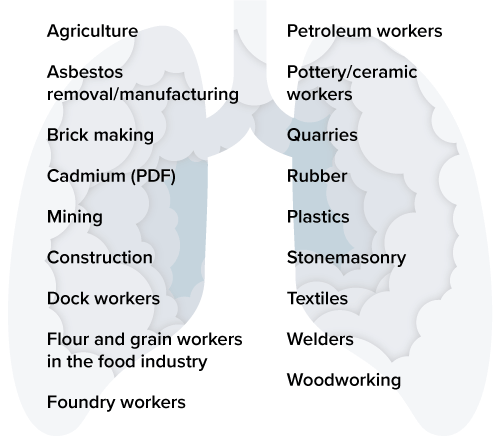
    Occupations related to Lung Disease

    Many workers could be subjected to conditions that may lead to respiratory issues in the incorrect environment, but as a rule it would be most likely in roles dealing with fibres, dust, chemicals, fumes, or other airborne particles.


    If you have worked in any of these industries and suffer from an ongoing respiratory disease that may have been caused by your employment, you could be eligible to claim compensation. The range of compensation for these types of cases can be from a few thousand pounds to hundreds of thousands of pounds.

    Respiratory-Disease-Occupations-sml-BLUE

    Respiratory Lung Disease

    1.6 million

    Workers suffering from work-related ill health (new or longstanding) in 2019/20

    Lungs-Diagram

    12,000

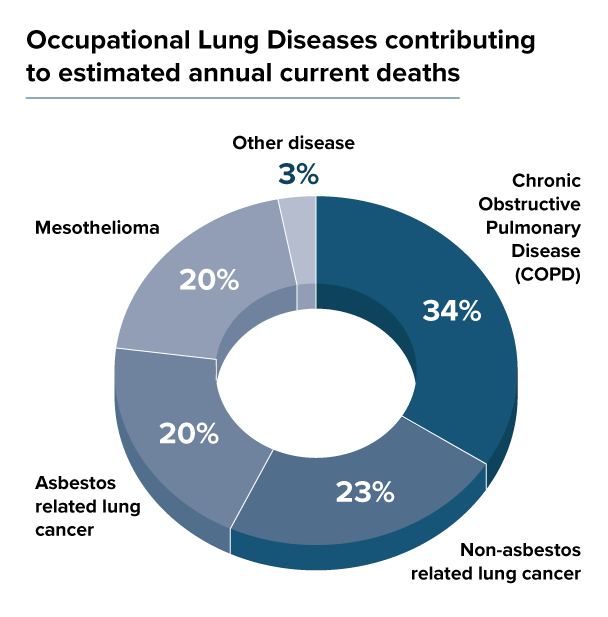
    Lung disease deaths each year estimated to be linked to past exposures at work

    It’s estimated that more than £19bn worth of welfare benefits go unclaimed in the UK every year. A solicitor can help you access expert advice to assess what benefits you may be able to claim. We have listed these below for reference.

    Means-Tested Benefits: Non Means-Tested Benefits:
    Income related Employment and Support Contributory Employment and Support Allowance (CESA)
    Allowance (ESA) Disability Living Allowance
    Income Support Reduced Earnings Allowance (REA)
    Pension Credit Personal Independent Payment (PIP)
    Housing Benefit Diffuse Mesothelioma Payment Scheme
    Working Tax Credit/Child Tax Credit Pneumoconiosis Etc. (Workers’ Compensation) Act 1979
    Universal Credit

    Losses we can recover for you

    When you live with a long term illness there are many aspects of your life that may require change. This could be by way of additional care needs or treatment costs or even the need to make adaptations to your home or find alternative accommodation.

    Loss of Earnings
    If you are unable to work due to your lung condition or are forced to retire early, then we help you recover those lost earnings.

    Treatment and Medical Costs
    If you require treatment or medication and that isn’t available on the NHS or you wish to fast-track that process, we can help you recover private healthcare costs to ensure that you receive the treatment or medication you deserve at a time when you need it most.

    Equipment Costs
    If you would benefit from specialist equipment or from adaptations to your home or vehicle, we can help you recover costs to help make your life more comfortable and improve your accessibility.

    Care Costs
    If you require care or are struggling to care for any dependants, we can help you recover the cost of private care to help you with all of your daily needs as well as for the costs to ensure that your loved ones are cared for in the event you are no longer able to care for them as you have done before.

    Accommodation Costs
    You may find that your current home no longer suits your needs, perhaps you live on a third floor apartment with no lift, we can help you recover the costs of having to move to a more suitable property.

    Travel Expenses
     If you’re having to make regular trips to hospital or other medical appointments, we can help you recover the costs associated with those.


     

    Free Assessment at Oakwood Solicitors

    FREE assessment.

    Please complete our short questionnaire.

    • Free initial consultation
    • Specialist dedicated industrial disease team
    • No Win, No Fee
    • Caring, client focused approach

    Can I make a claim?

      Submit

      Talking to the experts

      Oakwood Solicitors Ltd can work on your industrial disease claim on a ‘no-win, no-fee’ basis. If your claim is unsuccessful, you will not be expected to pay us a penny. If you are successful in your claim, we take a percentage of the compensation meaning that the only time we will receive money is if we have brought your claim to a fruitful conclusion.

      You will have a dedicated advisor who will see your claim through from start to finish, assisting you in the event of any queries or issues you may have. Your case handler will also continue to provide regular updates until the conclusion of your claim, ensuring the process is as stress-free and effortless as possible.

      A case study

      We represented Mr A in a claim against his previous employers for exposure to asbestos. He had developed lung cancer which reduced his life expectancy by 13 years.

      Uniquely, Mr A was the primary carer for his wife who required care in all aspects of her life including taking care of herself, washing and taking to medical appointments.

      If it weren’t for his cancer, he would have cared for her up until the end of her natural life.

      We negotiated a settlement figure in the global sum of £455,000 to include damages for Mr A’s pain and suffering, the cost of care rendered in looking after him and the costs of caring for his wife after his passing.

      Whilst this would never make up for the devastating loss Mrs A felt, she took comfort in knowing she would be financially secure and cared for which helped relieve some of her stress and worry.

      The journey of a typical Industrial Disease claim

      No two cases are the same, but as a general rule, the following steps are followed in the process of making an Industrial Disease claim against an employer. At Oakwood Solicitors we keep you informed at every step of the journey.

      1. Sign Up Procedure
        To ensure that we have your ‘No Win, No Fee’ agreement in place and the relevant authorities we require to investigate your claim.
      2. Disclosure Documents Search
        We will request and review copies of your medical records from the Defendants we are pursuing in your claim to ascertain whether there are any issues that may affect your prospects of success.
      3. Letters of Claim
        We shall formally notify the Defendants of your claim.
      4. Medical Evidence
        We shall instruct a medical expert to examine you and prepare a medical report to support your claim.
      5. Settlement
        We will then seek to negotiate a settlement with the defendants (and their insurers/solicitors).
      6. Court Proceedings
        To ensure that we have your ‘No Win, No Fee’ agreement in place and the relevant authorities we require to investigate your claim.

      Wills and Probate

      Planning for the future when you’re living with a chronic life-shortening illness is never easy.

      At Oakwood Solicitors, we pride ourselves in providing a compassionate and professional service to support you through end-of-life planning.

      Details of how we can help can be found on our webpage.

      Wills writing Occupational Lung Disease

      Oakwood Solicitors will provide a personally assigned specialist to guide you through the process.

      Industrial Disease Claims: Frequently Asked Questions

      How long can a claim take?

      The length of time for a case can vary, and can strongly depend on how Defendants and their insurers want to defend the action. It may take a considerable length of time to identify insurers for the Defendants if they are no longer trading, and the obtaining of evidence from experts in respiratory medicine (and potentially from health and safety experts or a chemical engineer) in regards to the exposure of chemicals can take a long time.

      A solicitor will also need to obtain the full list of your past employers from the HMRC, which can also take some time to obtain. The case can take anywhere from 12 months, up to 3–4 years to reach a conclusion.

      Is your job at risk if you make a claim?

      If you are still working for the defendant, they cannot dismiss you for making or proposing to make a claim. If your employer does attempt to do so, you are likely able to make a successful unfair dismissal claim. In our experience, the majority of insurers understand their duties owed to you and the right you have to pursue a claim if this duty has been breached.

      In most cases, the claim will normally be transferred from the Defendants directly to their insurers, and it will be the insurers who will deal with the defending of the action.

      Can you make a claim if you stopped working at the company a while ago?

      If you have only become aware of a problem recently and have only just noticed issues, then your action should be in time for limitation purposes. However, this is something that is solely evidence-based for each action, so it is strongly recommended that you speak with a solicitor to take further advice.

      Although a number of illnesses such as occupational cancer, noise-induced hearing loss (NIHL) and asbestos-related illness latency periods can be a number of decades, for other diseases such as occupational asthma, repetitive strain injury (RSI) and vibration white finger, you would expect these symptoms to manifest at the time of (or very shortly after) exposure.

      What is the duty of my employer to protect me from developing respiratory illness through work?

      As well as common law duty to ensure a safe place of work and a safe system of work, your employer will have a number of duties set down by statute.


       Health and Safety at Work Act 1974

      • Employers have a duty so far as is reasonably practicable to ensure the safety and welfare of their employees.

      Management of Health and Safety at Work Regulations 1999

      • Duty to undertake a reasonable risk assessment (Reg. 3)
      • Requirement to undertake a health surveillance (Reg. 6)

      Personal Protective Equipment at Work Regulations 1992

      • Ensure that suitable personal equipment is provided (Reg. 4)
      • Ensure an assessment of any personal protective equipment is undertaken to determine whether it is suitable.

      Control of Substances Hazardous to Health 2002

      • Required to assess health risk where work is liable to expose employees to substances hazardous to health (Reg. 6)
      • Ensure exposure to substances hazardous to health is either prevented, or where not reasonably practicable, adequately controlled (Reg. 7)
      • Ensure any employee exposed to substances hazardous to health are monitored and under suitable health surveillance (Reg. 11)
      X

      Get in touch

        If you are an existing client, please contact your case handler for an update.

        * Mandatory Fields

        Get in touch

          *Required fields

          You are leaving Oakwood Solicitors' website.

          Please click here to continue to the Oakwood Property Solicitors' website.

          Continue
          Property Transfer house graphic
          Loading

          Cookies

          This website uses cookies. You can read more information about why we do this, and what they are used for here.

          Accept Decline