Murders stemming from domestic violence have hit a five-year high in the UK.
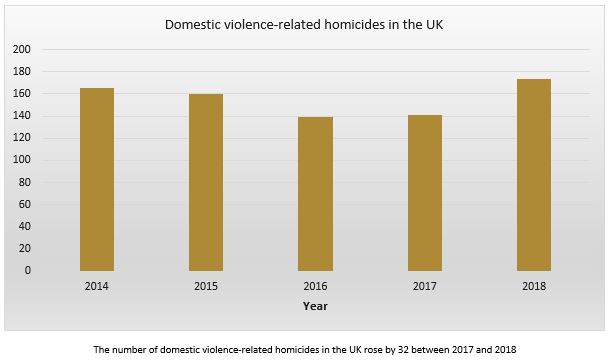
Research done by the BBC has found that the number of people killed as a result of domestic violence in the UK is now at its highest level since 2014.
In 2018, 173 people were killed in domestic violence-related homicides – an increase of over 20% when compared to 2017.
This revelation comes after Prime Minister, Boris Johnson, took to Twitter to announce that he will reintroduce domestic abuse legislation in the next Queen’s Speech.
The PM stated: “Domestic abuse shatters lives & tears families apart. We are fully committed to tackling this horrific crime – which is why the Queen’s Speech will confirm we will be reintroducing domestic abuse legislation in the next session.”
The Domestic Abuse Bill
In July, the domestic abuse bill was introduced in parliament. This new legislation will cover the following:
- It will introduce the first ever statutory government definition of domestic abuse to specifically include economic abuse and controlling and manipulative non-physical abuse. The aim of this is to enable a greater understanding of what constitutes abuse and encourage more victims to come forward.
- A Domestic Abuse Commissioner who will drive the response to domestic abuse issues will be established.
- New Domestic Abuse Protection Notices and Domestic Abuse Protection Orders to place restrictions on the actions of offenders and further protect victims.
- The cross-examination of victims by their abusers will be prohibited in the family courts.
- Automatic eligibility for special measures to support more victims to give evidence in the criminal courts will be provided.
These recent statistics show just how sorely the introduction of a domestic abuse bill is needed and how much it has been needed for some time. It was needed for people like Luz Margory Isaza Villegas, known as Margory, who, on 13th January, was stripped away from her family by her husband Alberto Rodrigo Giraldo-Tascon.
The couple had separated in January, but Giraldo-Tascon became obsessive about his wife and feared she was cheating on him. He went on to beat and strangle his wife to death in a fit of jealous rage. Giraldo-Tascon proceeded to put his wife’s body into a suitcase before setting it on fire and burying it in a shallow grave near Berkhamsted, Hertfordshire. He then told his three children that their mum had left. As with the majority of these cases, the killer had a history of domestic abuse.

Clare’s Law
The Domestic Violence Disclosure Scheme, also known as Clare’s Law, was introduced in 2014 to provide potentially life-saving information to prevent an individual being a victim of domestic violence. The initiative was named after Clare Wood, who was murdered by her ex-boyfriend in 2009. It allows the police to disclose information on request about a partner’s previous history of domestic violence or violent acts.
Even this, however, requires further improvement. Labour MP Graham Jones recently wrote to Home Secretary Priti Patel following the murder of Rosie Darbyshire. She was found on a pavement in Preston with injuries from at least 50 different blows after her boyfriend, Benjamin Topping, beat her to death in February.
Ms. Darbyshire had used Clare’s Law to put in a right-to-know request. Under the current law, police forces have 35 days to respond to request however, on the 11th day following the request, Ms. Derbyshire had still not received the request and she was murdered.
Topping was jailed for life in May. Mr. Jones raised a parliamentary question to the home secretary voicing his opinion that the timeframe to disclose this information should be shorter.

Criminal Injuries Compensation Authority
The Criminal Injuries Compensation Authority (CICA) was designed to compensate blameless victims of violent crimes, including physical and sexual assaults. Since the original scheme’s inauguration in 1964, the CICA and the CICA’s predecessor, the Criminal Injuries Compensation Board, have paid more than £3 billion in compensation.
While the CICA compensate for individual injuries, they can also compensate for sustained periods of abuse. Where a person has sustained a number of injuries as part of a pattern of abuse, payment will normally be made to reflect the pattern of abuse, based on the most serious injuries in the pattern, rather than each separate injury.
The exception to this rule is when a single injury sustained as part of the pattern of abuse would give rise to a higher payment than for the abuse. In this instance, the higher payment will be made instead of the award for the pattern of abuse.
Where Can I Learn More?
For more information on CICA claims, including the eligibility of an applicant, potential valuations and a full video guide on how a CICA claim works, please see here.
More needs to be done to tackle this heinous crime and the findings of the BBC will help to, once again, highlight the life-ruining impact that domestic abuse has. Margory’s son, Julian, recently stated “…realistically, what we actually need to do is work collectively as a community to create better things.” These are the words of a man who has needlessly lost his mother – it is important that we listen to them.
How do I invoke Clare’s Law?
Click here for further information and an online form from the West Yorkshire Police website, or call their non-emergency line – 101.
WHAT TO DO NEXT
For any advice or help with escalating a CICA claim, get in touch today for a free initial consultation in complete confidence. Choose one of the methods on the right-hand side of this page, or call us on 0113 200 9787 to find out how we can help you.
– Article by Daryl Smith
BBC Resource
Twitter Resource
Government Resource
BBC Resource 2
BBC Resource 3
BBC Resource 4
BBC Resource 5
Criminal Injuries Compensation Authority Claims for Victims of Domestic Violence – The Challenge
The CICA has strict conditions on making a claim which can result in Applicants having them rejected and having to go through a distressing Appeal process.
View
CICA – The First Offer
A widely asked question by people undergoing a Criminal Injuries Compensation Authority (CICA) claim is whether or not they should …
View
Making a Personal Injury Claim
When making a claim for Personal Injury, it is important for the Claimant to make sure that they are certain of the facts and figures before it is submitted.
View