At Oakwood Solicitors, we stand with victims of crime, fighting for the justice and compensation they deserve. However, a systemic decline at the Criminal Injuries Compensation Authority (CICA) is putting that justice out of reach.
What was designed as a support system has transformed into a series of administrative hurdles that undermine the very people it was built to protect. We are speaking out to challenge these restrictive changes and ensure that a survivor’s bravery is met with dignity, not a barrier to recovery.
What the CICA Scheme is Supposed to Do?
The Criminal Injuries Compensation Authority (CICA) is a government-funded scheme aimed at providing financial support and compensation to innocent victims of violent crimes such as physical and sexual assaults.
Nevertheless, recent changes in CICA’s protocols have had detrimental effects on individuals, transforming its intended safety net into a source of additional distress for survivors.
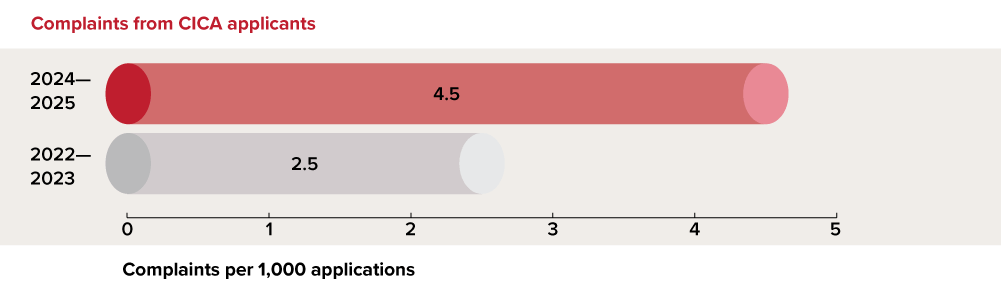
In October 2024, Oakwood Solicitors’ Criminal Injuries Department met with senior CICA management to address escalating concerns. Over the 2024–2025 period, Oakwood filed over 150 formal complaints regarding assessment timelines. Since then, that figure has risen to over 350 complaints in two years.
While the CICA’s latest Annual Review acknowledges a historic surge in complaints, the agency continues to ignore the root causes: deep-seated organisational dysfunction and a chronic inability to progress claims.
Despite years of private advocacy and repeated engagement between Oakwood Solicitors and the CICA’s leadership, no tangible progress has been made to stabilise the CICA operations.
What We Are Seeing in Practice:
1.Systematic Communication “Lockdown”
Between June 2022 and April 2025, the CICA effectively dismantled its transparency.
By removing email access in 2024 and subsequently closing phone lines for status updates, while removing the update request from applicants, it has created an information vacuum.
These changes make it impossible for legal representatives to provide vital updates to clients. Those individuals who don’t have the solicitor there to assure them that the CICA are looking at their claim, albeit very slowly.
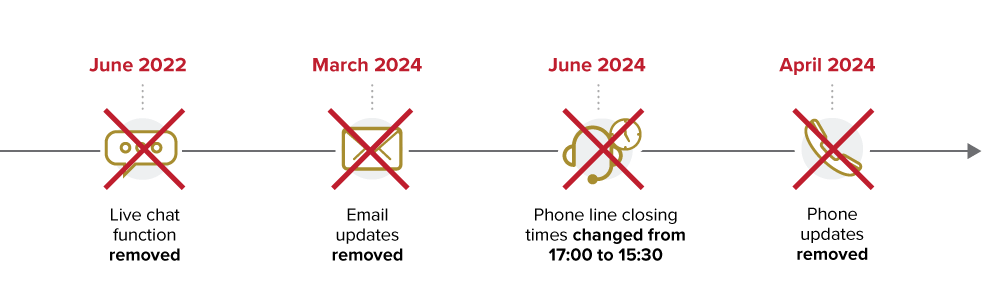
From an independent applicant’s perspective, it seems to them the claim has been rejected/ignored, given they won’t hear from the CICA for 6-10 months at a time.
Removing email support predictably spiked phone demand, which the CICA then “solved” by shutting down phone inquiries altogether.
By disconnecting phone lines and removing Live Chat, the CICA is treating survivors’ inquiries as a “burden”, which is a dehumanising practice to those already grappling with trauma.
As one client shared: “The CICA’s 12-month timeline doesn’t align with reality. This unfairness is taking a serious toll on my mental health.”
2. Excessive Delays and Redundant Reviews
The CICA has doubled its “realistic” timeframe for reviewing new evidence from three months to six. However, the true timeline is compounded by administrative hurdles:
- Evidence Review: 6 months.
- Complaint Resolution: An additional 12-week (3-4 months) wait.
- Total Stagnation: A survivor can wait 10 months to have a single piece of evidence acknowledged.
This 10-month administrative loop directly contradicts the CICA’s claim that an entire case should conclude within a year.
3. The Statistics vs. The Reality
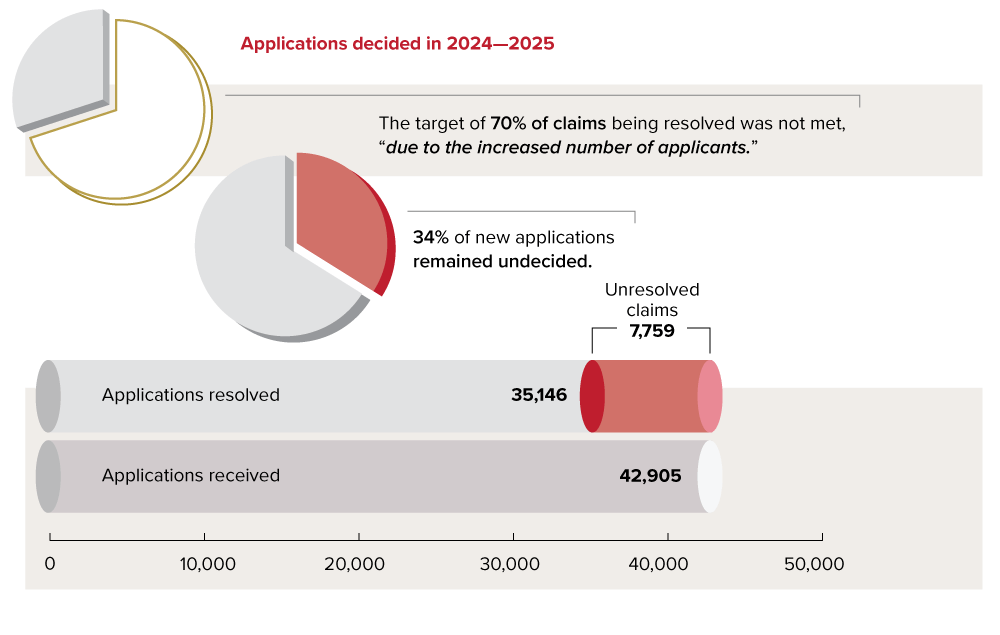
While the CICA reports that 66% of cases are decided within 12 months (and 68% within six), these figures mask a “darker reality.” Professional insights suggest the rapid six-month resolutions are often “quick rejections” based on technicalities rather than genuine settlements.
Therefore, the CICA’s reliance on “high demand” to excuse delays is mathematically inconsistent. While the agency cites a 13% rise in applications, the data show only a 4% increase. Suggesting that internal inefficiency, rather than volume, is the true culprit.
The Impact on Victims
Beyond the administrative failures, the true cost of the CICA’s decline is the human impact.
By restricting communication and extending delays, the CICA is neglecting its core mission: supporting survivors of domestic abuse, sexual violence, and catastrophic physical attacks.
For individuals already facing trauma, “no news” is not merely an inconvenience; it is a source of profound anxiety. Survivors require a process rooted in compassion and transparency, yet the CICA increasingly treats human lives like figures on a spreadsheet.
This clinical approach ignores the unique vulnerabilities of applicants and creates risks such as:
- Emotional and Psychological Harm: Most applicants are already dealing with permanent physical or psychological injuries. A lack of transparency and a “blackout” on updates increases anxiety and feelings of abandonment.
- Financial Strain: While compensation is never guaranteed, many victims face long-term financial instability due to their injuries. Prolonged, silent delays only exacerbate this pressure.
- Re-traumatisation: Navigating a bureaucratic system that treats survivors as “numbers” rather than human beings can force victims to relive their trauma without the comfort of knowing their case is moving forward.
Consequently, there is a call for a swift re-establishment of a “client-first” approach that recognises the victims’ realities and reinstates dignity in the compensation process.
Why the System Needs Reform
Beyond the logistical hurdles, there is a significant risk for independent claimants compared to those with legal representation.
Statistics reveal that professional representation has become the only dependable safeguard against the agency’s tendency to undervalue or dismiss valid claims. Without an advocate, claimants face a structural disadvantage that threatens the very principle of a fair hearing.
- 2020-21: Applicants without legal representation received an average payout of £8,692, while represented applicants averaged £13,545.
- 2022-23: At the appeal stage, represented cases saw compensation increase by up to six times the initial offer, jumping from an average of £7,848 to £47,339.
- 2024-25: Currently, 30-40% of initial decisions are revised in favour of the applicant upon review or appeal, suggesting a high rate of initial error.
What Needs to Change
While the mission behind the CICA is vital, its current operational methods are failing the very people it was designed to protect. Meaning change is crucial.
We believe there are practical, cost-effective ways to manage increasing caseloads without alienating applicants:
- Restore the Live Chat Function: By assigning a dedicated team for real-time digital queries, the CICA can promptly address applicant concerns, enabling the primary Case Working Team to concentrate on progressing claims without interruptions from basic status inquiries.
- Empower the Customer Resolution Team: During a meeting last year, CICA confirmed that Customer Resolution staff are trained to issue decision letters. However, claims resolved through the complaints process still undergo a redundant 8-week review by the Decision-Making Team, which, if eliminated, would streamline the final stages of the process.
- Implement a Digital Progress Portal. The CICA should introduce a secure online portal where applicants and representatives can log in using their reference number and personal details. A visual timeline, showing which steps (police reports, medical records, etc.) have been completed, would eliminate thousands of unnecessary “status update” phone calls.
Beyond technical fixes, the CICA requires a fundamental shift in its approach to survivors. This must include:
- Enhanced Guidance: Clearer, accessible support for self-represented applicants to ensure they aren’t “vetted out” by technicalities.
- Empathetic Discretion: Fairer consideration regarding “late reporting” in cases where trauma prevented the victim from coming forward sooner.
- Modernised Medical Recognition: A more sophisticated understanding of the long-term impact of mental and psychological injuries.
- Operational Honesty: Setting realistic timeframes that align with reality rather than internal quotas.
The current policy of silence is not a solution to a high caseload; it is a catalyst for more complaints. We must transition back to a system that supports recovery rather than compounding trauma.
Our Call for Action
The CICA’s current trajectory disregards the very people it was created to serve. We are witnessing a system that treats survivors as a burden rather than as individuals seeking justice. This must change.
We are calling for an urgent Government review to end the “culture of silence” and replace it with transparency, efficiency, and compassion. Every signature brings us closer to a system that honours a survivor’s bravery instead of stalling their recovery.
No survivor should be left to navigate the dark alone. At Oakwood Solicitors, we refuse to stay silent. Help us amplify this message and demand a fairer system by signing our petition today.
 Standing Up for Victims
At Oakwood Solicitors Ltd, our commitment goes beyond legal advice; we are dedicated to being a voice for those who have been silenced by trauma and bureaucracy. We understand that the path to recovery is difficult, and we believe the legal process should be a support, not a burden.
We are committed to making justice accessible to everyone. We operate on a strict “no-win, no-fee” basis, meaning you pay nothing unless your claim is successful.
To ensure your comfort, you will be assigned a dedicated advisor to manage your case from start to finish, and we are happy to provide a female advisor upon request to support the sensitive nature of your claim. Ensuring your journey toward justice is as stress-free and effortless as possible.
WHAT TO DO NEXT:
Stand with us and Join our movement for fair justice, sign our petition today! Get in touch today for a no-obligation consultation.
Sign our petition: Urgent Review and Reform of the CICA Scheme, to join our movement towards justice.
Choose one of the methods on the right-hand side of this page or call us on 0113 200 9720 to find out how we can help you.
Gabrielle Henry joined Oakwood Solicitors Ltd in September 2021 and is a Paralegal in the Criminal Injury Department. Initially, Gabrielle completed work experience with Oakwood Solicitors within the …
What is a “No Win, No Fee” Agreement?
If you're considering a compensation claim but are worried about the financial risk. A no-win, no-fee agreement, also known as a Conditional Fee Agreement, can offer a solution.
…
View